Showing posts with label Hyundai. Show all posts

Hyundai ix35, 2011

Hyundai ix35, 2011


The Hyundai ix35 development team moved away from the two-box off-roader look in favor of a sleeker, more reformed profile while aiming for a roomier cabin, extra storage capacity and fuel economy leadership.

Hyundai's new "fluidic" design language finds confident expression in the sweeping, gently curved lines of the Hyundai ix35. The hexagonal grille previewed on the Hyundai ix-onic concept at the 2009 Geneva Motor Show moves into mass production on the Hyundai ix35, a defining look that will serve to unify the family of future Hyundai products. To achieve the desired dynamic and sporty image, Hyundai ix35 gets an aggressive belt line coupled with a low-to-the-ground feel which is enhanced by the optional 225/55 R18 wheels.

The interior lines echo the dynamic flow of the sheet metal. For improved comfort, the designers have carved out extra legroom and headroom (whilst lowering the overall height of the vehicle). The feeling of spaciousness in the cabin is further enhanced by the new dual-panel panoramic sunroof, benefitting front and rear passengers. The center panel can either tilt open or can open completely by sliding up and over the rear panel.

The Hyundai ix35 rides on a 2640mm wheelbase which is 10mm longer than the outgoing Hyundai Tucson. At 4410mm and 1820mm, it is also longer and wider than its predecessor (by 85mm and 20mm, respectively) greatly improving the interior cabin space but the overall height of 1660mm has been lowered by 20mm without affecting headroom.

Greater travel in the front seat adjustment gives more legroom and headroom for taller drivers. The centre console box has been enlarged to 6.2 liters for more storage. In addition, the height of the rear cargo screen has been raised for extra capacity and a small storage binnacle has been added in the rear cargo area.

To further broaden its appeal, Hyundai ix35 will get the newest fuel-efficient engines and six-speed manual and automatic transmissions. Western European customers will be offered a choice of two thrifty and clean-burning petrol engines: the Theta-II 2.0 rated at 166ps and 20.1kg.m of torque which emits just 178g/km (2WD MT) of CO2 and the Gamma 1.6 GDI delivering 140ps and 17kg.m of torque, available from November 2010, which delivers only 158g/km of CO2. This 1.6 GDI engine will be available with ISG stop-start technology, further reducing CO2 to just 149 g/km.

The European diesel lineup includes two all-new engines: the R 2.0 and the U-II 1.7, which will be available from November 2010. The R 2.0 will come in a choice of two outputs: high (184ps/40kg.m) and low (136ps/32kg.m) producing CO2 emissions of just 165g/km (2WD MT) and 158g/km (4WD MT), respectively. The U-II will have a rated output of 115ps with 26.0kg.m and will have class-leading CO2 emissions of just 149 g/km (2WD MT) when equipped with ISG. To achieve Euro-5 emission compliance, the R is fitted with a close-coupled diesel particulate filter plus highly efficient exhaust gas recirculation with by-pass valve.

6-speed manuals are standard with both diesels while the R will come with the option of a six-speed automatic. Hyundai's all-new six-speed automatic transaxle helps the company meet its goals of improving fuel efficiency and reducing CO2 emissions. Shifts are silky-smooth with an option of sporty-type, manual shifting through the Shiftronic which is also new to the Hyundai ix35.

The new fuel-efficient engines and transmissions, the Hyundai ix35 features a number of other innovations which contribute to lower operational costs. Nestled between the speedometer and tachometer, the "ECO" coach is a new feature designed to promote fuel-saving driving habits. In the manual transmission version, an icon on the LCD trip-ometer screen begins to flash when the optimum gear shift point is reached. The automatic uses an "ECO" icon backlit by LEDs with either the red, white or green LED lighting up in accordance with driving behavior. Fuel savings in the range of 15 to 17 percent are attainable with the automatic "ECO" coach and 7 to 9 percent with the manual.

The multi-link rear suspension was adopted not only for its superior ride and handling characteristics but also because of its compact design which minimizes intrusion into the cabin creating extra space for passengers and cargo. Tried and true Macpherson struts are employed for the front suspension set-up.

The body shell structure is engineered to the very highest standards of safety: In crash safety tests conducted in-house Hyundai ix35 scores a five-star rating in Euro NCAP testing for both frontal and side impacts. The entire body shell has been made stiffer and lighter thanks to its more extensive use of ultra-high tensile strength steel.

In a panic braking situation, the emergency flash signals are automatically triggered thus reducing the risk of rear-end crashes. Active headrests are triggered by the pressure of the seat occupant's weight on the backrest, the headrests automatically moving upwards and forwards to help prevent injuries to head, neck and upper body.

4WD capability, Hyundai ix35's CUV credentials are strengthened with two new safety features: Hill start Assist Control and Downhill Brake Control which promote safer travel up and down steep slopes.

For safer maneuvering in reverse gear, a rear-view camera has been added, which operates in conjunction with a 3.5-inch color LCD built into the rear-view mirror. Smart-Parking Assist uses the rear-view camera to provide a graphical grid overlay to safely guide the driver into the parking spot.

Another new features:
    = Push button start with smart-key proximity sensor
    = Manual tilt and telescopic steering wheel
    = Steering wheel-mounted audio remote control
    = Air-conditioned, cooled glove box
    = Low rolling resistance tires for 16" wheels

Hyundai Sonata Hybrid, 2011

Hyundai Sonata Hybrid, 2011


As global automakers work out implementation timing for new fuel-efficient powertrain technologies such as gasoline direct-injection (GDI), twin-scroll turbochargers, and full-hybrid powertrains, Hyundai announced that the all-new 2011 Hyundai Sonata is the first vehicle in the industry to offer all three technologies with the new Sonata 2.0T (turbo) and Hyundai Sonata Hybrid joining the hot-selling GDI-equipped Sonata in Hyundai showrooms in late 2010.

At the 2010 New York auto show, Hyundai unveiled its 2011 Sonata Hybrid, changing the game in hybrids with unique approaches in hybrid powertrain design, battery technology and vehicle appearance. The Sonata Hybrid is Hyundai's first hybrid in the U.S. market.

The Hyundai-developed Hybrid Blue Drive architecture is a full parallel hybrid drive system, which can operate on an electric motor, gasoline internal combustion engine, and a combination of the two depending on driving conditions and driver demands. Hyundai's proprietary full parallel architecture differs from the power split technology used by most competitors, allowing significant efficiency advantages at higher speeds. Hyundai Hybrid Blue Drive is the first and only system using lithium polymer battery technology - leapfrogging competitive in-market nickel-metal hydride and lithium-ion applications. Lithium polymer offers the benefits of lithium-ion, a technology used in laptops and cell phones, but adds robustness, power-density and package flexibility, making it ideal for automotive applications. Hyundai Hybrid Blue Drive also is unique in its use of the company's own highly efficient, compact new 6-speed transmission, modified with hybrid starter-generator, electric motor, and low-friction oil pump, which together allow the elimination of the traditional torque converter.

PERFORMANCE
Hyundai Sonata Hybrid's projected best-in-class highway fuel economy of 39 mpg offers significant benefit to hybrid owners with highway commutes, while also offering outstanding city fuel economy of 37 mpg. Government studies have shown that the typical U.S. driver operates in a highway mode 57 percent of the time. Hyundai's approach to deliver class-leading fuel economy in highway mode provides a unique solution in the mid-size sedan hybrid market, and differentiates Hyundai Sonata Hybrid from the likes of Toyota Camry Hybrid and Ford Fusion Hybrid. Hyundai Sonata Hybrid delivers typical hybrid fuel economy gains in the city like its competitors, but also gives owners outstanding fuel economy on the highway, where these competitors fall short.

Hyundai Sonata Hybrid delivers class-leading electric-vehicle operation at steady-state speeds of up to 62 miles per hour. Gasoline engine engagement depends on state of charge, acceleration and vehicle speed. Its two propulsion units develop a total output of 209 horsepower at 6,000 rpm, exceeding all mid-size competitors, and 195 lb-ft of torque. The weight-efficient architecture of the new Sonata platform, combined with the lightweight lithium polymer battery pack, make the Hyundai Sonata Hybrid the lightest vehicle in the segment, at just 3,457 pounds, 263 pounds lighter than the Fusion Hybrid. Combined with Sonata's best-in-class horsepower rating, Hyundai Sonata Hybrid has a significant advantage in power-to-weight ratio, a key enabler of both performance and efficiency.

HYUNDAI'S HYBRID BLUE DRIVE ARCHITECTURE
Hyundai's Hybrid Blue Drive is a proprietary parallel hybrid drive system that runs on the already fuel-efficient 2.4-liter Theta II engine (169 horsepower at 6,000 rpm and 156 lb-ft of torque at 4,500 rpm) mated to a 6-speed automatic transmission and a 30kW (151 lb-ft) electric motor for maximum fuel economy. Hyundai's Hybrid Blue Drive has an all-electric mode and a parallel drive mode. This means the wheels are turned by power coming directly from the gasoline engine, or the electric motor, or both together, as conditions demand. This parallel hybrid drive architecture will serve as the foundation for future hybrid drive vehicles to be developed by Hyundai.

In the Hyundai Hybrid Blue Drive system, the Theta II with multi-port fuel injection (MPI) operates on an Atkinson Cycle. Atkinson Cycle is a type of internal combustion engine strategy designed to dramatically increase fuel efficiency through changes in compression and power strokes in the four stroke engine. It is typically only used in hybrid systems where the high-torque electric motor boosts low-end power, which is traded off for internal combustion engine efficiency. By combining the electric motor and the Atkinson Cycle engine, the Hybrid Blue Drive system delivers best-in-class highway hybrid efficiency.

The high-tech, all-aluminum, 16-valve engine also features Continuously Variable Valve Timing (CVVT) on both camshafts and newly developed engine components to reduce friction. This optimized Theta II engine achieves 10 percent better fuel consumption over a conventional Theta II engine.

Hyundai Hybrid Blue Drive uses the company's proprietary 6-speed automatic transmission rather than a conventional hybrid's CVT. Hyundai's strategy involves an adaptation of the modular 6-speed transmission, replacing the torque converter with an electric motor and high-efficiency oil pump. This technique uses a traditional step-shift 6-speed transmission rather than a CVT to provide a more traditional shift feel that is preferred by customers and sometimes artificially replicated in CVT applications. This saves on cost, making the Hyundai Hybrid Blue Drive system a better value. It is a more robust and elegantly simple solution to a complicated engineering challenge.

Hybrid Blue Drive is made up of the following major components:
    * An efficient 30kW electric motor delivering 151 lb-ft of torque
    * A regenerative braking system
    * An integrated starter generator that enables the engine to turn off at stops and restart automatically under acceleration
    * A breakthrough lithium polymer battery package, with 5.3 Ah of capacity at 270 volts
    * A fuel-efficient Theta II 2.4-liter engine
    * 6-speed automatic transmission with an improved efficiency electric oil pump
    * Weight-efficient architecture coupled with a low drag coefficient (.25 Cd target)
    * Electric air conditioning compressor
    * Hybrid power control unit

LITHIUM POLYMER BATTERY TECHNOLOGY
Sonata's hybrid system stores its electrical charge in a 270V lithium polymer rechargeable battery (5.3Ah/270V) that surpasses existing nickel-metal hydride and pending lithium-ion applications. Lithium polymer batteries are more durable and space-efficient than other hybrid batteries. They are also more weight-efficient. The Hyundai Sonata Hybrid's battery pack weighs just 95.9 pounds versus the Camry Hybrid's 123.9 pounds. The compact battery pack resides in the forward portion of the trunk to maximize cargo space.

Lithium Polymer Batteries vs. Nickel-Metal Hydride Batteries
Compared with nickel-metal hydride batteries, lithium polymer batteries deliver the same power with 20-30 percent less weight, 40 percent less volume and 10 percent greater efficiency over the nickel-metal hydride batteries found in today's hybrids. Lithium polymer batteries offer 1.7 times more energy density than nickel-metal hydride batteries, allowing Hyundai engineers to devote less space and weight to the battery pack. Lithium polymer batteries hold their charge 1.25 times longer. Lithium polymer batteries also are more resistant to changes in temperature, which improves cycle life. Additionally, lithium polymer's self-discharge rate is less than a third of a nickel-metal hydride battery.

Lithium Polymer Batteries vs. Lithium-ion Batteries
Lithium-polymer has significant advantages over lithium-ion, including higher energy density and lower manufacturing costs. Lithium polymer is more resistant to physical damage and can handle more charge-discharge cycles before storage capacity begins to degrade. Lithium polymer technology also offers significant advantages in thermal robustness and safety.

A key difference between traditional lithium ion batteries and Hyundai's lithium polymer battery solution is the overall packaging of the cell - the anode, the cathode, the electrolyte, and the encasement material. Traditional lithium-ion batteries, like those found in laptops, use what's known as the 18650 cell format. In this format, each mass-produced cell is 18 mm. in diameter and 65 mm. tall, which is a bit larger than a "AA" battery. Each of these small metal cylinders is filled with a liquid electrolyte that facilitates the movement of lithium ions across anode and cathode, creating the battery current.

Traditional lithium-ion batteries are easy to handle, withstand mild internal pressures, and have been around in various forms since 1991. That means a manufacturing infrastructure is in place, and economies of scale are reasonably high. However, they do have several disadvantages. For example, their cylindrical shape reduces packaging efficiency and they are surprisingly complicated to manufacture since they have so many small parts. These small parts make them robust to thermal fluctuations and add significant cost and weight to the overall battery system. Cell-to-cell consistency also is extremely critical in a vehicle battery package, since the pack is only as robust as its weakest cell. Traditional lithium-ion batteries have considerable cell-to-cell variation, while Hyundai's lithium polymer batteries deliver outstanding cell-to-cell consistency.

Lithium polymer technology uses a completely different approach. Rather than using a liquid electrolyte, which requires a robust metal casing, lithium polymer batteries use a polymer gel as the electrolyte, which allows the use of a thinner and lighter aluminum-walled encasement, or pouch. Inside each lithium polymer cell, the cathode, separator, and anode are laminated together, enabling much simpler and more reliable manufacturing. This allows the battery pack to be about 20 percent smaller than a lithium-ion battery pack, making it much easier to change the cell footprint to fit the nooks and crannies of available vehicle space.

Hyundai and its battery supplier, LG Chem, have spent hundreds of hours testing the Hyundai Hybrid Blue Drive lithium polymer battery system. This testing has proven that Hyundai's lithium polymer technology has greater thermal and mechanical stability than existing systems, meaning better safety and performance.

Another key engineering challenge for Hyundai Hybrid Blue Drive has been assuring maintenance-free battery operation over the vehicle's life - at least 10 years, and 150,000 miles - in all weather conditions. Heat is the enemy of battery cycle life. Hyundai's thermal imaging testing shows how much cooler a lithium polymer battery is compared to today's nickel-metal hydride battery or a conventional lithium-ion battery. Consumers will notice these advantages in improved useful life and lower maintenance costs.

FLUIDIC SCULPTURE DESIGN ADDS A UNIQUE ECO FLAIR
Hyundai designers have taken Sonata's fluidic sculpture design language a bit further with Hyundai Sonata Hybrid, making it even more aerodynamic. The goal was a modern, eco-friendly design, with "at-a-glance" differentiation from the non-hybrid Sonata models.

    * Unique exterior design elements
          o Headlights and taillights
          o Aerodynamic bumper fascias
          o Aerodynamic rocker panels
          o Bold hexagonal grille
          o Eco-spoke wheels
          o Air dam and aero side sills
          o Hybrid Blue Drive badging
          o Exclusive hybrid paint color
    * Interior refinements
          o Supervision cluster with eco-display options
          o Unique interior color choice
          o Unique seat patterns

Hyundai Santa Fe Blue Hybrid Concept, 2008

Hyundai Santa Fe Blue Hybrid Concept, 2008


The vehicle maintains the overall design and dynamics of the standard Hyundai Santa Fe, but is altogether a different car under the hood. Hyundai engineers developed a proprietary parallel hybrid drive system which mates the powerful but thrifty 2.4-litre Theta engine to a six-speed automatic transmission and a 30Kw electric motor for maximum fuel economy and substantially reduced CO2 emissions. And it also can be used as a generator in order to save regenerative electric energy to the battery. This proprietary parallel hybrid drive architecture will serve as the foundation for all future hybrid drive vehicles to be developed by Hyundai.

Hybrid Technology
The petrol-electric hybrid technology featured in the Hyundai Santa Fe Blue Hybrid reduces CO2 emissions to just 148 g/km (combined cycle) and delivers a fuel consumption figure of 6.2l/100km (combined cycle). With an estimated top speed of 170 km/h and a 0-100km/h acceleration time of 10.6 sec.
To maximize fuel economy, all of the Theta's major driveline and cooling system components have been optimized to reduce friction, while the crankcase has been filled with low friction oil engine control software automatically shuts off the engine when the vehicle comes to a halt, cutting emissions to zero. When pressure is reapplied to the accelerator pedal, the Integrated Starter Generator (ISG) automatically restarts the engine. The Theta's engine control software governing injection pressure, engine cycle timing and exhaust retreatment rates has been revised to further reduce fuel consumption.
In addition, the latest electric motor-assisted steering system reduces power drain, and very low resistance tyres further optimize fuel economy.

Electric propulsion for the Hyundai Santa Fe Blue Hybrid is provided by a 30kW electric motor (205Nm) which is coupled directly to the six-speed automatic tranmssion. The top three gear ratios have been extended to ensure lower engine revolutions per minute (RPM) and further enhance fuel economy. Electrical power is stored in a 270V Lithium Polymer rechargeable battery (5.3Ah/270V) which has significant advantages over lithium-ion batteries, including higher energy density and lower manufacturing costs. Li-Poly is also more resistant to physical damage and can also take more charge-discharge cycles before storage capacity begins to degrade.

To be sold initially in the Korean domestic market under the Avante badge, the Elantra LPI Hybrid will be the world's first electric hybrid vehicle to be powered by liquid petroleum gas (LPG) and the first to adopt advanced Li-Poly batteries.
Hyundai's developed its very first hybrid electric vehicle in 1995 when it unveiled the Future Green Vehicle at the Seoul Motor Show. In 1999 it displayed an Elantra Hybrid Electric Vehicle (HEV) at the Seoul Motor Show and, in 2000, an Accent HEV - both of which featured 'hard-type' parallel electric drive systems and Integrated Starter Generator technology. However, these research development vehicles did not go into mass production.
In 2004, the company moved its HEV program into low-volume test production, delivering 50 examples of a gas-electric hybrid Hyundai Getz (B-segment vehicles badged as Hyundai Click in the Korean domestic market) to Korean government agencies as part of a fleet demonstration project. These were 'mild-type' hybrid systems using 12kW motors and nickel metal hydride batteries. The hybrid technology development program continued to expand and, in 2005, Hyundai and its affiliate Kia Motors Corp. delivered 350 more units to the demonstration fleet, 730 more units in 2006 and 1,682 more units in 2007, including Accent HEVs.

Innovative Panoramic Roof

The Hyundai Santa Fe Blue Hybrid features an innovative three-piece panorama sunroof. The moveable glass top has UV filtration which reduces thermal loading without restricting light transparency. And to protect cabin occupants against solar radiation, an adjustable shade can be operated separately from the glass top. The modular system solution was developed Magna Car Top System.

Hyundai i-flow Concept, 2010

Hyundai i-flow Concept, 2010


Making its global debut at the 2010 Geneva Motor Show, the Hyundai i-flow Concept car carries forward the company's evocative new form language, 'fluidic sculpture'. The flowing, elegant lines not only create a bionic, futuristic shape, but also contribute to exceptional aerodynamics, helping to reduce the car's CO2 output to just 85g/km and fuel consumption to only 3l/100km.

Hyundai's first diesel hybrid powertrain is also a key factor in delivering such an environmentally-conscious return, as is the application of next-generation materials and technologies developed in cooperation with leading chemical company BASF.

Previewing a future D-segment contender
With an overall length of 4.780mm and a 2.800mm wheelbase, the Hyundai i-flow Concept brings new ideas and a pioneering form to the traditional European D-segment. The dramatically-sculpted forms of the interior and exterior make for a striking sports sedan, and its width and height (1.850mm and 1.420mm respectively) give it an athletic stance.

The name i-flow reflects the exceptionally aerodynamic shape and the flowing lines of the concept car's eye-catching styling, and retains the 'i' prefix of Hyundai's established alphanumeric nomenclature for Europe. In 2011 Hyundai will bring into production a new challenger in the segment, drawing on the Hyundai i-flow Concept's sleek styling and innovative technology.

Inside: minimum weight, maximum space and a bionic feel

The interior of Hyundai i-flow Concept redefines the perception of space in a sedan bodystyle. Fundamental elements, such as the seats and center console, were crafted for minimal weight and volume using cutting-edge materials from BASF - one of the world's leading automotive suppliers.

The seats, for example, were developed in conjunction with BASF using advanced stress analysis, which highlighted the unnecessary mass areas and pointed towards an optimized lightweight seat structure. 'Steron', a BASF material, gives the seats a highly-resilient quality, excellent breathability and a high-tech touch.

The upper dashboard, meanwhile, is treated with Elastoskin, a sprayed skin from BASF for a sophisticated, shimmering finish.

This technical, meticulous approach combines with an abundance of natural materials to engender a bionic feel in the cabin, further symbolized by the green color tones and the leaf-like shadows projected from the roof's semi-transparent dye-sensitized solar cells.

The cockpit's main interface centers around an expansive, contoured screen, which recognizes not only touch but also gestural inputs along its fascia-wide display. The fluidic forms of the exterior are echoed in the Hyundai i-flow Concept's cabin, where continuous lines sweep from the dashboard, through the doors to the open storage area at the rear.

The innovative, B-pillarless doors allow comfortable ingress and egress for passengers. The front door is hinged at the A-pillar, and the rear door swings backwards on an intelligent hinge arm system to allow unrestricted access to the rear seats. Additionally the front seats can be turned 30° towards the outside, to invite the driver and co-driver to enter the ultramodern lightweight seats.

An eco-technological test bed
The Hyundai i-flow Concept is a test bed for new energy harvesting ideas, ranging from flexible solar panel roofing to a thermo-electric generator. The key technical components of the vehicle have been developed by Hyundai under the Blue Drive™ banner in cooperation with BASF. Blue Drive™ remains at the heart of Hyundai's product development strategy, and continues to drive the company towards its target of global leadership in environmentally-sensitive technologies.

Energy Conservation
BASF and Hyundai R&D engineers have developed thermal engine encapsulation, which ensures that the engine reaches optimum operating temperature more quickly, by retaining heat when the car is at idle. Where a non-insulated engine would take three hours to drop to 40°C, the Hyundai i-flow Concept will stay above that temperature for 14 hours. This translates into fuel savings and emissions cuts of 5 per cent during summer and up to 9 per cent during winter.

Energy Harvesting
Another pioneering technique introduced in collaboration with BASF is thermo-electric waste heat recovery. This process equates to further reductions in fuel consumption, 5% at highest driving. In fact, up to half of the electrical energy consumed by Hyundai i-flow Concept at 80kph - 250 watts - can be recovered through the work of a thermo-electric generator. Harvested energy from hot exhaust gases is recaptured by this generator which is fitted into the exhaust manifold. The thermal electric generator then converts the wasted heat into useful electrical energy to help power auxiliary systems.

Liquid Metal, a coating with the appearance of a glossy skin made of liquid metal, has been developed by BASF Coatings. Special effect pigments in this eco-friendly waterborne coating system let the surface appear as polished metal with targeted mirror like reflections - this gives a liquid skin appearance to the car's exterior and increases the tension of the surface in the same time. The high color saturation on the Hyundai i-flow Concept adds an energizing charisma to the Hyundai concept car. The typical high contrast between highlight and flop underlines the sculptural impact of the Hyundai i-flow Concept.

Hyundai Sonata Midsize Sports Sedan

Hyundai introduced its all-new Hyundai Sonata at the 2009 Los Angeles Auto Show. This marked the North American debut of the latest version of the popular midsize sedan, introducing Hyundai's "Fluidic Sculpture" design language and an all four-cylinder engine lineup to the U.S. market. Hyundai Sonata is the second vehicle in Hyundai's 24/7 version 2.0 product initiative (seven new models in the next 24 months) following on the heels of the all-new Tucson. Production of Hyundai Sonata will begin in December 2009 at Hyundai's U.S. plant in Alabama with retail sales beginning in January 2010.
Hyundai Sonata Midsize Sports Sedan
The new Sonata will launch with Hyundai's new Theta II GDI 2.4-liter four-cylinder engine with a Gasoline Direct-Injection (GDI) fuel delivery system, which contributes to improved fuel efficiency and lower emissions. Hyundai Sonata is the first midsize sedan to adopt GDI technology as standard equipment in a naturally aspirated powertain. This shorter, more direct path of fuel delivery, allows for greater control of the fuel mixture at the optimum moment, thus improving efficiency. The fuel is injected by a camshaft-driven, high pressure pump that operates at pressures up to 2,175 psi. Direct injection also utilizes a higher than normal 11.3:1 compression ratio for increased power. The pistons are "dished" to increase combustion efficiency in the cylinder. This powerplant will deliver best-in-class fuel economy, best-in-class four-cylinder horsepower and best-in-class torque.
The Sonata 2.0T, as the car is officially named, is powered by a new 2.0-liter Theta II twin-scroll turbocharged gasoline direct-injection (GDI) engine that produces 274 horsepower at 6,000 rpm and 269 lb-ft of torque from 1800-4500 rpm with regular fuel. The engine is linked to a six-speed automatic transmission with SHIFTRONIC manual control that drives the front wheels. No performance figures were released but Hyundai did announce that the Sonata 2.0T will deliver an estimated 22 mpg (10.7lt/100km) city and 34 mpg (6.9lt/100km) highway.
The 2.0-liter twin-scroll turbo engine will be available on the Sonata SE and Limited trim level, with the Limited getting additional upgrades, including a panoramic sunroof, 18-inch "hyper" silver alloy wheels, dual exhaust system and steering wheel-mounted paddle shifters.
Next year, Hyundai will add a 2.0-liter Theta II turbocharged GDI four-cylinder engine and a 2.4-liter Hybrid Blue Drive model featuring Hyundai's breakthrough lithium polymer battery pack. Details about these powertrains will be announced at the 2010 New York Auto Show. Hyundai Sonata's innovative segment first powertrain lineup is a key driver of Hyundai's goal to be the most fuel-efficient automaker on the planet.
Hyundai's commitment to making the Hyundai Sonata extremely fuel efficient continues with a six-speed automatic transmission with SHIFTRONIC manual control or a standard six-speed manual transaxle. Hyundai's all-new six-speed automatic A6MF2 transaxle helps the company meet its goals of improving fuel efficiency and reducing emissions. Shifts are silky-smooth with an option of manual control through the SHIFTRONIC feature.
Developed over a four-year period, this new six-speed automatic is 26.4 pounds lighter than the five-speed it replaces. It also is 1.6 inches shorter and considerably simpler, having 62 fewer parts, which is a key to increased durability, lighter weight and lower cost. When it comes to transmissions, more gears are definitely better. The addition of a sixth gear enables closer spacing between gear ratios providing a better balance of performance and fuel economy while the wide overall gear ratio helps deliver strong acceleration.
All Sonatas have column-mounted, motor-driven electric power steering that adjusts instantly to changing driving conditions while improving fuel economy over a conventional steering system. A quick-ratio steering rack is used for crisp feel on turn-in. Hyundai Sonata's turning diameter of 35.8 feet is better than Camry, Accord, Altima, Fusion and Malibu.
One of the program targets for the 2011 Sonata engineering team was world-class power-to-weight ratio. Power-to-weight ratio pays dividends in both performance and fuel economy. Hyundai Sonata is rich in ultra-high-strength steel, leading to world-class body rigidity. The 2011 Hyundai Sonata is 25 percent stiffer in torsion and 19 percent stiffer in bending rigidity than its predecessor, yet it is lighter than many midsize sedans, also offering more interior room.
The 2011 Sonata is a smart combination of superior styling, performance, safety and fuel efficiency. What’s more, it’s an affordable midsize car, putting a luxurious and rewarding driving experience within reach of many. Make the 2011 Sonata a part of your future.

2011 Hyundai i30 Magna in India - Specifications, Features and Prices

New Hatchback, Hyundai i30 Magna
Korean automaker Hyundai Motor Company, also the world's sixth-largest automobile company are all set to launch a new Next "i-series" hatch for the indian market after Hyundai i10 and i20, and it is named as Hyundai i30 Magna. This new Hyundai i30 Magna, which is a small family car, is expected to reach here by the early 2011. In short, this new Hyundai i30 Magna is dynamically stylish, invitingly spacious and totally practical.

This new Hatchback model Hyundai i30 Magna, which belongs to the B+ segment in the Indian market measures 4,245 mm long, 1,765 mm wide and 1,480 mm high. Also a wheelbase of 2,650 mm offers significant interior space for a vehicle of this size. Total luggage space is 340 liters with the rear seats upright. Some of the notable features in this new Hatchback, Hyundai i30 Magna are dual front, side, and curtain airbags, active headrests, seatbelt pretensioning and seatbelt reminders.

This new Hyundai i30 Magna features a 1396cc, 4 Cyl DOHC Petrol Engine which will provide a Maximum power of 107.5 Bhp @ 6200 rpm and a Maximum torque of 137.2 Nm @ 5000 rpm. Hyundai will offer a variety of diesel and gasoline engines with the i30, ranging from 90 to 140 horsepower. A choice of either an automatic transmission to a five-speed all-synchro gearbox will also be offered.

This new Hyundai i30 Magna provides a top-speed of about 187 kms and it will take only about 12.60 secs to acclerate from 0 to 60 kms. This new Hatchback from Hyundai, i30 Magna will provide a mileage of around 12 kmpl in the highways and around 9 kmpl in the cities. It should be noted that the suspension used in this car is Independent MacPherson Strut.

Hyundai i30 Magna will be priced between 9 to 12 lakh INR ex-showroom.

Tags :- Hyundai, Hyundai i30, i30 Magna, Hyundai i30 Magna, New Hatchback Hyundai i30 Magna, Latest Hatchback Hyundai i30 Magna, Upcoming Hatchback Hyundai i30 Magna, New Hyundai i30 Magna in India, Hyundai Hatchback's in India, New Hyundai i30 Magna launch in India, New Hyundai i30 Magna launch date in India, New Hyundai i30 Magna specs, New Hyundai i30 Magna price in India, New Hyundai i30 Magna pictures, New Hyundai i30 Magna details, New Hyundai i30 Magna features, New Hyundai i30 Magna reviews, New Hyundai i30 Magna technical specifications, New Hyundai i30 Magna mileage, New Hyundai i30 Magna top-speed, New Hyundai i30 Magna photos, New Hyundai i30 Magna pics, New Hyundai i30 Magna wallpapers, Photos of New Hyundai i30 Magna..

New Hyundai Avante Sports Sedan

Hyundai Motor Co. had its world-premier of the all-new Hyundai Avante compact Sports sedan, the company's best-selling model worldwide, at the 2010 Busan International Motor Show. The fresh 2011 new Hyundai Avante, badged because Hyundai Elantra in commercialises largest Korea comes on Hyundai’s latest 1.6L Gamma gas Direct Injection locomotive and a 6-speed automatic drive to the front-wheel drive compact, the 1st time GDI and six-speed automatic rifle have been boasted on a contract sedan in Korea.
Hyundai Avante
The fresh Avante delivers a peak end product of 140ps and level best torque of 17.0kg-m. They are also almost 10 percent a lot fuel efficient than thems closest challengers, cheers to GDI, the six accelerate automatic and additional fuel economy sweetenings.The fresh Hyundai Avante will enchant and surprise on a raft of additional advanced characteristics not found on additional compacts, admitting HID (High Intensity Discharge) headlights, LED compounding lamps in the back, heated back end seats, puddle lamps and a color in TFT LCD entropy display nestled in the caliber cluster.
"The new Hyundai Avante encompasses Hyundai's latest ambitions, featuring the best styling and performance in its class," Steve S. Yang, President & CEO of Hyundai's Global Business Division, said at the Busan Exhibition and Convention Center (BEXCO) today. "We're confident that it will once again redefine the compact segment worldwide."
With sportier and even more elegant lines than its predecessor, the new Hyundai Avante - badged as Elantra in markets outside Korea - continues Hyundai's 'fluidic sculpture' design philosophy.
Hyundai has applied its latest 1.6L Gamma Gasoline Direct Injection engine and a 6-speed automatic transmission to the front-wheel drive compact, the first time GDI and six-speed automatic have been featured on a compact sedan in Korea. The new Avante delivers a peak output of 140ps and maximum torque of 17.0kg•m. It is also about 10 percent more fuel efficient than its closest competitors, thanks to GDI, the six speed automatic and other fuel economy enhancements.
The new Hyundai Avante will delight and surprise with a raft of other advanced features not found on other compacts, including HID (High Intensity Discharge) headlamps, LED combination lamps in the rear, heated rear seats, puddle lamps and a color TFT LCD information display nestled in the gauge cluster.
Under the Avante/Elantra badge, Hyundai has sold over 6 million units worldwide since the car's launch in 1990. Hyundai will begin sales of the all-new Hyundai Avante in the second half of 2010 in Korea.

2011 Hyundai Elantra – LA Auto Show

 2011 Hyundai Elantra – LA Auto Show
This week, 2011 Hyundai Elantra revealed the US-spec version at LA Auto Show. It powered by a 1.8-liter Nu engine backed by a Hyundai-developed 6-speed transmission or a 6-speed manual, the Elantra boasts a 40 mpg highway, and 29 mpg city fuel ratings on any and every model.

2011 Hyundai Elantra offer the car’s wheels will range from 15 to 17 inches, depending on the packages selected, while all models will get the 148-horse / 138 lb-ft engine that’s cleaner than some hybrids. Elantras in some states will be rated at 145 horsepower and 130 lb-ft of torque while earning the right to be classified as PZEVs (Partial Zero Emission Vehicles).

In interior passenger also can enjoy with equipment is available includes: a touchscreen nav system, iPod integration, segment-busting heated rear seats, and a 172-watt or 360-watt sound system, making the Elantra one potentially decked-out looker of a small car.

About price, began assembly this month down in Alabama, will be hitting lots before the end of 2010 with a starting MSRP of $14,830 (before a $730 delivery fee). That price includes standard stability control, traction control, anti-lock brakes, and a trunk-full of other electronic nannies.

2011 Hyundai Elantra

 2011 Hyundai Elantra
2011 Hyundai Elantra U.S-spec model gets a larger displacement 1.8-liter gasoline unit with conventional port fuel injection rated at 148-horsepower and 131 lb-ft of torque. Hyundai estimates that the U.S. model will return a highway efficiency of around 40mpg.

Unique Hyundai Genesis G37 Coupe

Apparently, Hyundai has its own version of cars. The Hyundai Genesis coupe looks and smells like the Infiniti G37 coupe. The two sport coupes look so similar that Edmund’s Insider Line decides to feature an article about them. The comparison includes comments like these:

Hyundai ix-onic Concept, 2009

Hyundai ix-onic Concept, 2009


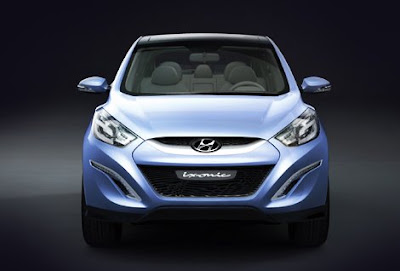
The designed to assertive but not aggressive, the Hyundai ix-onic Concept (pronounced "ik-sonnik") combines dynamic styling with an environmentally-friendly power train and thoughtful everyday utility. It creates a vehicle that will change the way consumers think about compact crossover vehicles.
With an overall length of 4,400mm, the 1,850mm-wide and 1,650mm-high Hyundai ix-onic Concept has an imposing stance and road presence but takes up little more space on the road than a C-segment hatchback.

The Key attributes of Hyundai's 'dynamic sculpture' design philosophy are the athleticism and sophistication that ix-onic demonstrates through its dynamic and flowing lines. These are emphasised by specially developed, high-contrast exterior paint. Employing an advanced-effect pigment, the innovative paint gives the car's skin a brilliant shine.

The hexagonal grille is a further evolution of the style introduced on the 2006 Genus concept car and developed for its appearance on the Hyundai i-mode concept in 2008. The headlamps feature innovative LED daytime running lights which move down electrically whenever the 'dipped beam' is switched on.

The profile of Hyundai ix-onic Concept features a dynamic glass line and a sports car-like theme with a muscular, double-zigzag treatment for the wheel arches that wrap around the 21-inch polished alloy wheels. Unusually, the concave sills have a wedge-shaped profile which extends rearwards and wraps around into the rear bumper. The sills and bumper are finished in a contrasting colour, with an aluminium garnish that echoes the trim in the door handles to enhance the perception of premium quality.

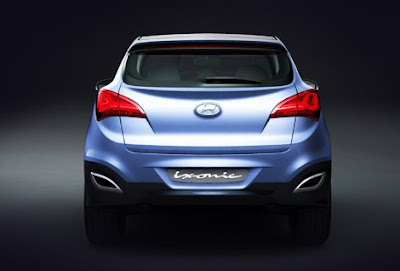
With high-mounted tail lamps, multi-surfaced glass and a sculpted bumper, the rear of Hyundai ix-onic Concept also incorporates 'dynamic design' elements. The rear lamp clusters feature a grille mesh inspired by nature, while the rear bumper also neatly incorporates the dual, polished aluminium exhaust tailpipes.

The rear window has been designed and produced by Hyundai in close cooperation with the QarmaQ-partner SABIC Innovative Plastics. Using Lexan high-performance plastics instead of conventional glass enabled the designers to give the rear window a much more three-dimensional shape. On each side of the rear window two vertical spoilers are integrated to reduce aerodynamic drag. The upper part of the window features a strongly concave shape to make it possible to integrate the roof spoiler in the rear window.

The Inside, the five-seater Hyundai ix-onic Concept offers a commanding view of the road and evokes an adventurous ambience that is also laid-back and relaxing.

An X-shaped visual theme is repeated across numerous areas of the cabin, with embossed leather to accentuate key areas while light-alloy magnesium accents provide flashes of visual brilliance. The sleek shapes of the interior are outlined with 'ice blue' seams that replicate the colour of both the ribbed ice blue floor carpet, which contains a high percentage of natural cashmere wool, and the exterior.

Shapely seats feature centre panels trimmed in breathable fabric with attractive and functional cushion side bolsters, plus additional lateral support for occupants' shoulders - all trimmed in contrasting magnesium grey.

The mounted much higher than usual in the doors, the audio speakers present occupants with a true and highly detailed, top-quality sound reproduction. The interior rear-view mirror has a 'blind spot' warning light that alerts the driver to other road users in close proximity.

The Beneath its sensational exterior, the Hyundai ix-onic Concept's power train is equipped with a 170PS, 1.6-litre GDi turbocharged, four-cylinder petrol engine, with ISG (Idle Stop & Go) technology and a double-clutch six-speed transmission. Power is transferred to the road by an intelligent four-wheel drive system fine-tuned to deliver outstanding on-road driving dynamics, together with significant off-road ability. The next-generation, eco-friendly engine emits just 149 g/km of CO2, an impressive figure for an SUV and comparable with conventional hatchbacks and superminis.

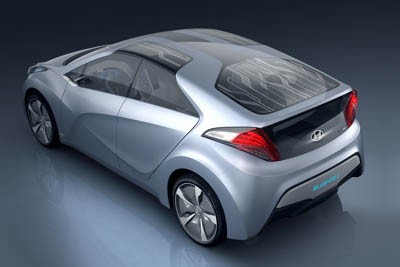
Hyundai Blue-Will Concept, 2009

Hyundai Blue-Will Concept, 2009


The Hyundai has revealed the first pictures of an innovative plug-in hybrid Hyundai Blue-Will Concept car. It has exceptionally advanced technology crammed inside its striking bodyshell.

The Recycled PET soft drink bottles were used to make the material for the headlamp bezels while use has also been made of bio-plastics: PLA for the interior while PA11 was specified for the engine cover. These materials are made from plants extract rather than fossil fuels and are bio-degradable.

The Hyundai Blue-Will Concept is powered by an all-aluminium Gasoline Direct Injected 1.6-litre engine which is coupled to a Continuously Variable Transmission and a 100kw electric motor which is at the heart of Hyundai's parallel hybrid drive architecture.

The Electric power, stored by a Lithium Ion Polymer battery pack, is neatly bundled with the fuel tank under the rear seat to maximise luggage space.

The Hyundai will be the first automaker in the world to apply Lithium Ion Polymer in a mass production vehicle.

A further expression of the concept's design flexibility is found on the panoramic roof. The glass area integrates dye-sensitized solar cells which can generate power for the batteries from the sun without impeding visibility.

Luxury Car Hyundai iX-Onic Concept Car


Hyundai ix-onic concept is a preview for the next generation Tucson crossover that will debut end of the year. Currently we don’t know how many styling cues will be taken from the concept to the production model, but we hope a lot. Questionable marketing decisions aside, the ix-onic, which previews the next Tucson crossover, is a winner. Aesthetically, it has some mildly derivative elements (the face has a certain Mazda quality about it), but it's a good-looking vehicle that comes off bigger and more muscular than its 173-inch length suggests. In other words, it's got presence.
The exterior also has some innovative touches, including headlamps with cool – if slightly contrived – moving internal elements (check out the video after the jump), and as well a coral-like asymmetrical grille mesh and very strong upswept greenhouse that shows off a clean, less hard-edged interior. That said, we could do without the heavy-handed chrome wheels that look like they were cribbed from the guys over at West Coast Customs.
Hyundai’s European designers have done a great job. ix-onic concept looks a lot bigger than it actually is. In fact it is only 4,400 mm long and 1,850 mm wide.
Interestingly, with the ix-onic, Hyundai designers are now going on record saying they are working toward defining a "hexagonal" front graphic as the company's new universal corporate face.
How the latter proclamation fits in with new offerings like the Genesis Sedan and Coupe or the Equus is something of an open question (perhaps this is just on designs for the European market), but as aesthetic signatures go, we can see this idea working to Hyundai's advantage, as the company's offerings currently don't really have a familial design element to tie them together.
The ix-onic – pronounced "ik-sonnik" – makes use of Hyundai's brand-new 1.6-liter GDi turbo four-cylinder, which routes its 168 horsepower through a six-speed double-clutch transmission (a bit of tech we don't recall seeing from Hyundai before), and the drivetrain has stop-start tech to help it yield a commendably low 149 grams-per-kilometer of C02. With Hyundai's previous admission that the company will move toward all direct-injection engines, we can expect to see this powerplant coming to America in the next Tucson, although perhaps not immediately.

Luxury Car Hyundai iX-Onic Concept Car Hyundai iX-Onic Concept Car - Rear View
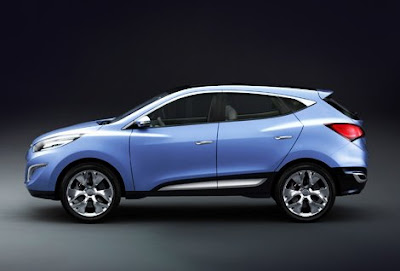
Luxury Car Hyundai iX-Onic Concept Car Hyundai iX-Onic Concept Car - Side View

Luxury Car Hyundai iX-Onic Concept Car Hyundai iX-Onic Concept Car - Front Left View
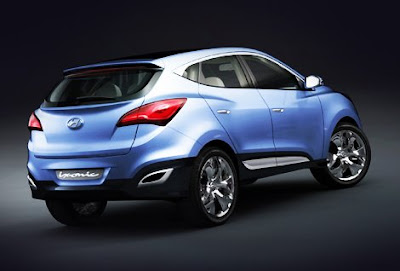
Luxury Car Hyundai iX-Onic Concept Car Hyundai iX-Onic Concept Car - Rear Right View